Writing DiagnosisFailureRepair
We were certain it was the water pump
A car came in overheating with two hours on the clock. We told the owner the water pump was dead before we'd had it in our hands. It came off perfectly fine, and so did the thermostat. The actual problem was a radiator packed solid with mud.
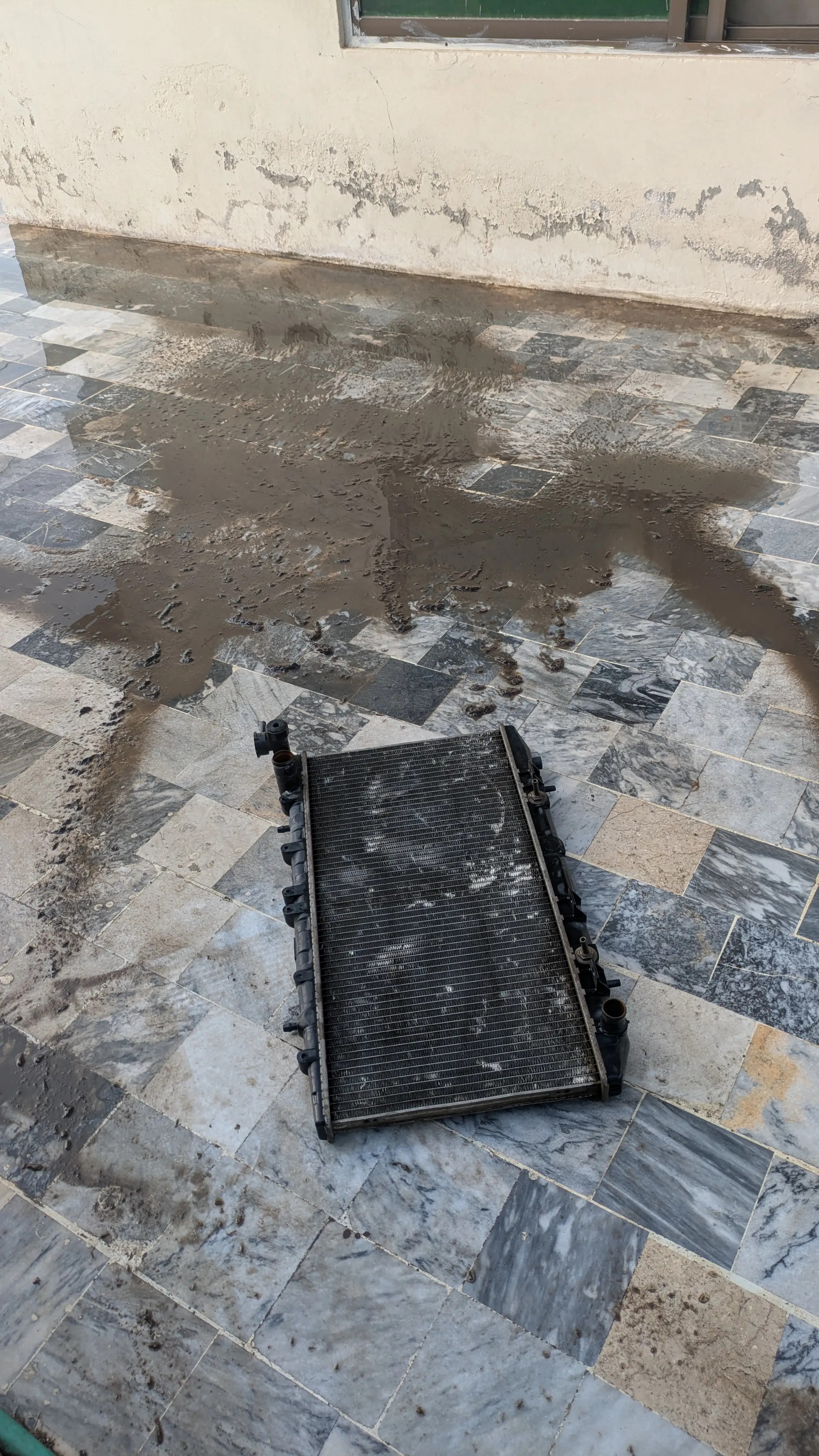
A Nissan Sunny B14 came in overheating, with a QG15 swapped into it. The owner needed it back in two hours because he had a trip he couldn’t move.
The problem was intermittent but it had a pattern to it. Moving, the car was fine. Sitting at a stop, the needle climbed. And once it got hot it stayed hot. You couldn’t drive it and have it come back down on its own. The only thing that worked was pulling over and switching the engine off.
What we’d already checked
The fan wasn’t a suspect. We’d tested it on an earlier visit with a meter on it, 1800 rpm wired straight to the battery and 1600 through the factory wiring. The owner had been running the car with the fans wired direct to the battery anyway. So when it came in this time we didn’t go back and look at the fan again.
That’s where this actually started going wrong, though not in the way you’d think. Hot when parked and fine when moving is an airflow problem. We knew that much. But we’d checked the fan, and the fan was healthy, so we ticked airflow off in our heads and went looking at coolant instead. Those aren’t the same thing and we didn’t notice we’d swapped one for the other.
The shortcut
With two hours on the clock we didn’t open anything up. We worked it out from outside the engine: a thermostat stuck shut would explain heat with nowhere to go. So the plan was to take the thermostat out completely, let him do his trip on an engine that would at least run cool, and fit a new one properly afterwards.
We took it out. Nothing changed.
We drove the car and the gauge climbed anyway. Back at the workshop we let it idle and it kept climbing. Then we revved the engine, and the temperature dropped. Not gradually, all at once.
That felt like an answer. An impeller that’s come loose on its shaft will slip at idle and bite when the revs come up, and what we were watching looked exactly like that: rev it, the fins catch, cold water comes through from the radiator, needle falls. We said it out loud. The pump’s dead.
What we hadn’t thought about was the bypass. This engine has an internal bypass, and with the thermostat gone it sits open all the time, so the coolant takes the short way round inside the engine instead of going out to the radiator. At idle there was barely anything moving through the radiator at all. Rev it and the pump pushes hard enough to force some coolant round the long way, and down comes the needle. Same behaviour as a slipping impeller, completely different cause. So taking the thermostat out didn’t just fail to help. It produced the one symptom that would send us straight at the pump. We thought we were removing a variable and we’d added one.
It was past ten at night by then. We sorted another car out for the owner, told him we’d have the pump changed by morning, and sent him off. He made his trip fine.
The next morning
We got the pump off and it was clean. Vanes all there, nothing weeping. We went straight for the thing we’d convinced ourselves of and checked whether the fins were properly fixed to the pulley shaft, and they were. Solid. No slip in it anywhere.
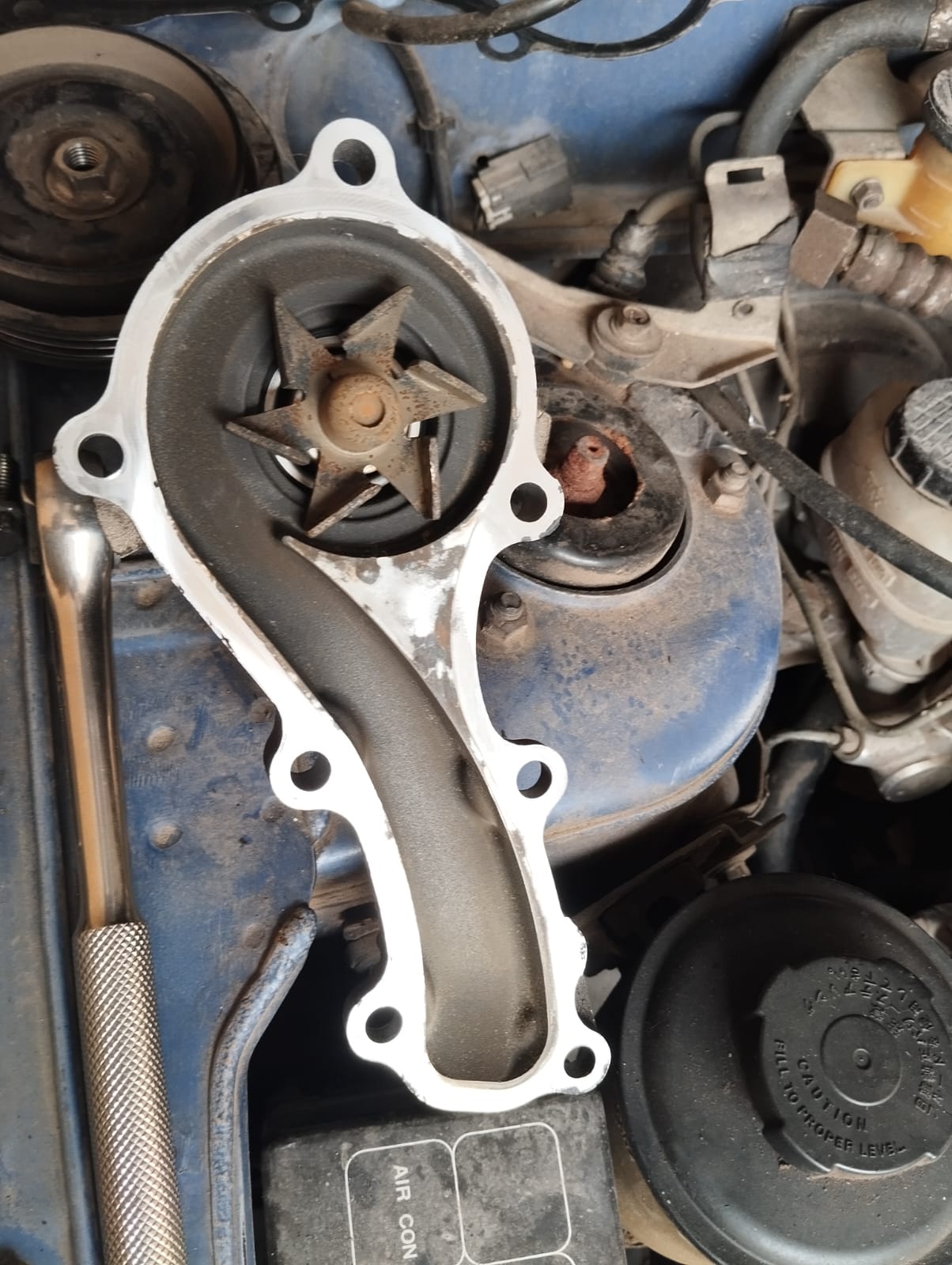
Then we dropped the thermostat we’d pulled the night before into hot water to see what it would do. It opened right when it was supposed to.
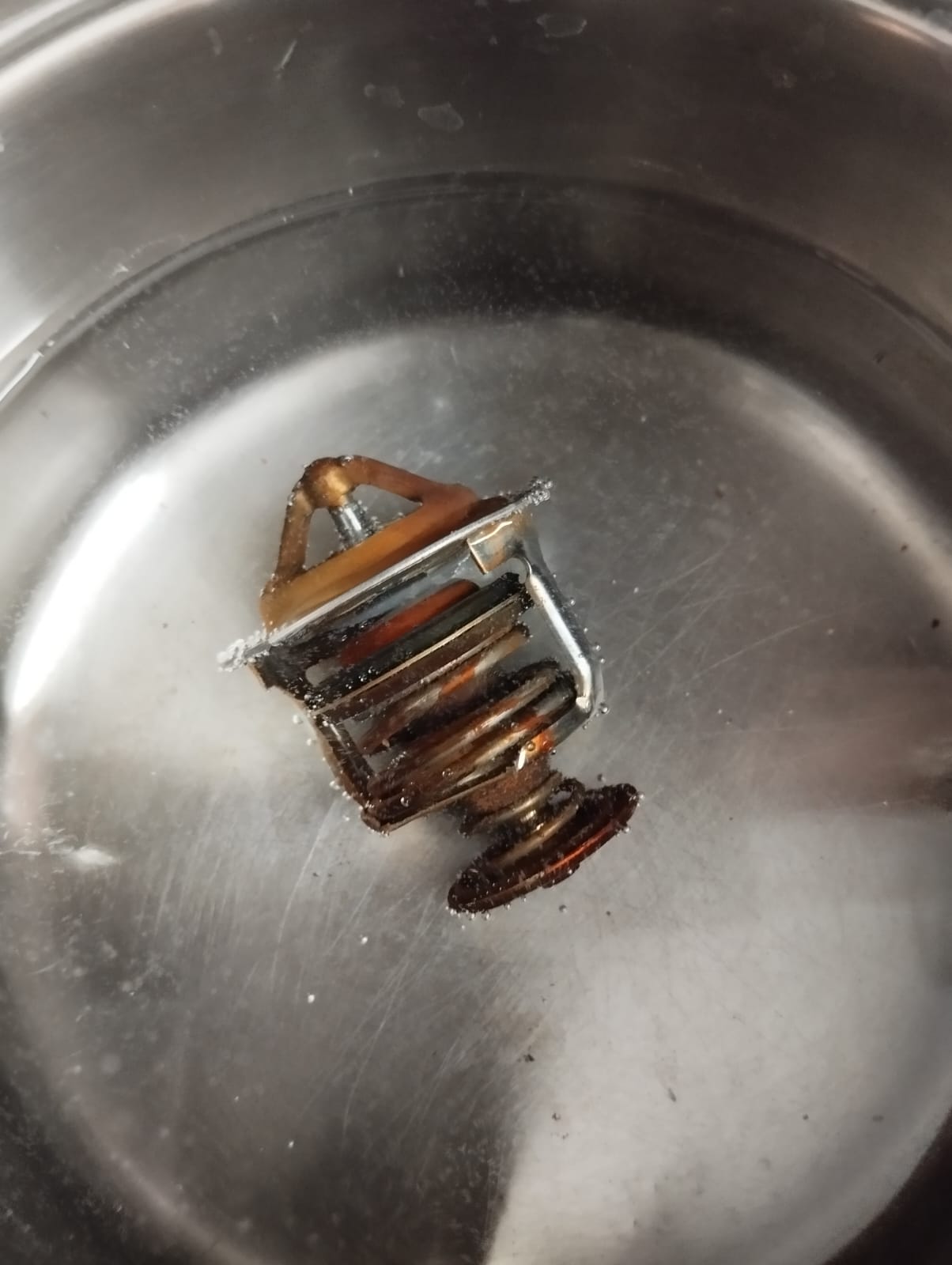
So that was two parts we’d written off, and both of them were fine.
The radiator
We went back to looking. First thing we checked was the gap between the condenser and the radiator, in case something had got wedged in there, leaves or a rag or a bit of plastic. It’s a tiny gap and you have to peer down through it, but there was nothing in there.
Then we took the radiator out and held it up against the light. Hardly anything came through. A bit of a glow in a few spots and dark everywhere else. It wasn’t the tubes and it wasn’t the coolant side. The fins were packed from the outside, so the core was fine and the air just had nowhere to go. Sitting in the car with everything bolted up around it, it had looked completely normal.
We put a pressure washer through it and mud came out. We kept going and it kept coming, pass after pass.
The radiator went back in and the original thermostat went back in with it, since it had tested fine and there was no reason to buy a new one. We did the AC job on the car in the same turn, which put a new condenser in front of the radiator. Then we took it out in traffic with the AC running, which is about the worst you can ask of a cooling system, and the needle sat where it should. The car was fixed.
One thing we should be straight about, since we changed two things before we tested. The old condenser was dirty as well, just nowhere near as bad. Next to the amount of muck that came out of the radiator it wasn’t in the same league, and we’re confident the radiator was doing nearly all of the damage. But we didn’t test them one at a time, so we can’t put a number on it.
What we got wrong
The car didn’t need a single new part. What it cost was most of two days and a diagnosis we’d already given the owner.
That last bit is the part worth talking about. We told him it was the water pump before we’d ever had it in our hands, and we were confident when we said it. What saved us was that we hadn’t actually bought the pump yet. We could go back to him and say the part we’d blamed was fine, and here’s what it really was. If the order had already gone in, he’d have paid for a part that had nothing wrong with it.
The rest is smaller. Checking that the fan turns isn’t the same as checking that air gets through the core, and we treated one as proof of the other. Pulling a thermostat isn’t a free test on this engine either, because the bypass changes how the coolant moves rather than just taking a part out of the equation; we reached for it because it was quick, and it cost us more time than it saved. And every conclusion we came to before the radiator, we came to from outside the engine with a clock running.
The fan one is the only thing we’re changing our habits over. I’m thinking of buying an airflow meter and adding it to the protocol, so that when we say airflow is fine we mean we measured the air coming through the core, not that we watched the fan spin and assumed the rest.
The radiator was the cheapest thing in the whole job to check. You take it out, hold it up and look through it. It took a minute, once we got round to doing it.